Additive manufacturing processes can be classified into seven categories:
Vat-photopolymerization
Vat photopolymerization, or the photopolymerization of a liquid, is an additive manufacturing process in which a liquid photopolymer in a vat is selectively cured using light-activated polymerization. It is the oldest 3D printing process, which was patented as early as 1986.
In vat photopolymerization, the liquid photopolymer in a vat is selectively cured using light-activated polymerization. The term used in the standard, VAT Photopolymerization, comes from the fact that the process takes place in a vat.
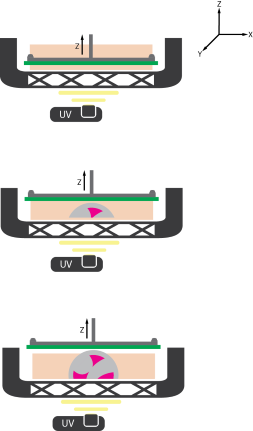
The tank is filled with liquid, and the object is either lifted layer by layer from the tank, curing the bottom layer through a transparent base plate at the bottom of the liquid tank, or the object is lowered deeper into the tank while simultaneously curing the surface layer. Nowadays, the first of the aforementioned methods is most commonly used, as it reduces the amount of liquid required. The adjacent image illustrates the principle of the process.
After the layer has hardened, the print platform is raised above the liquid surface, it is ensured that the liquid is evenly spread (usually with a wiper or scraper), and then the print platform is lowered back into the liquid.
Because the platform and the 3D-printable part attached to it are lifted out of the liquid between each layer, there are often problems related to this process. In cup-like structures, a vacuum can form that resists lifting the part out of the tank, which in the worst case can cause the part to detach from the print platform.
However, the part is not ready immediately after the printing process is finished; the process involves mandatory post-processing steps. After the printing process, the parts need to be washed, and depending on the application, they usually need to be post-cured in a designated UV chamber (curing oven). Due to the liquid nature of the material, some liquid remains on the surfaces of the part during the printing process. The most commonly used washing liquid is isopropanol (IPA), so the washing should be performed in a well-ventilated area.
Parameters that need to be defined before printing include layer height, material, part orientation, the location, type, and sinking of support structures into the base material.
Like other 3D printing processes, devices based on liquid photopolymerization are divided into several different techniques, of which the two most common are stereolithography (SLA) and DLP.
Stereolithography is a technology in which an object is selectively cured layer by layer from a liquid photopolymer using a UV laser. DLP is otherwise similar to SLA, but it uses a projector as the light source. With a projector, the entire area can be exposed at once, making the process faster than a laser beam.