Savonia’s 3D-scanning services
Price list
- Scanning: 130 € / hour + vat
- Includes all scanning-related procedures (positioning, scanning, model output as point cloud or surface model)
- Travel costs
- Finnish Tax Administration mileage compensation (2024: 0,57 € / km)
- Hourly rate 60 € / hour + vat
- Post-Processing: 90 € / hour + vat
- Includes surface model correction/modification as needed and delivery in the file format required by the customer
Software in use: Ansys Spaceclaim DirectModeler, Polyworks Inspector & VX Elements..
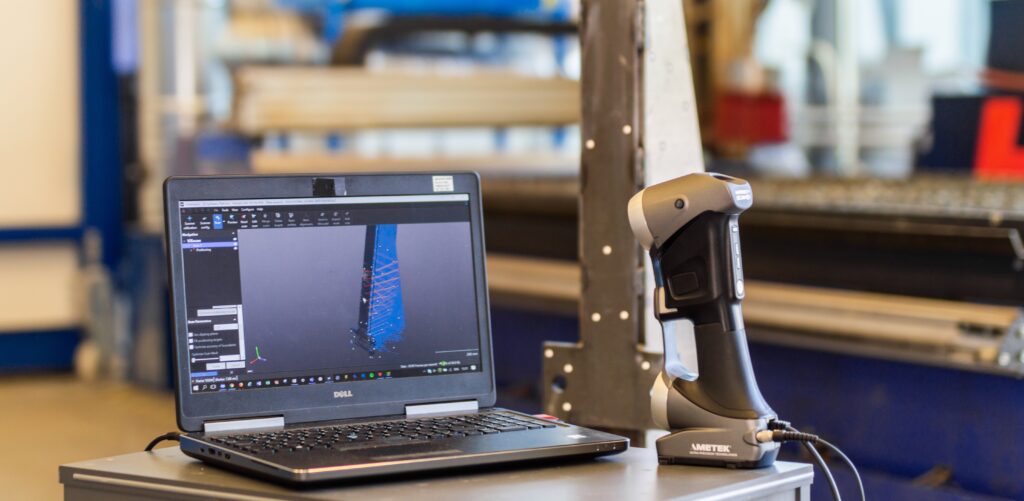
3D scanning typically aims to produce either a measurable or post-processable surface model. Savonia’s equipment and methods are suitable for everything from heavy engineering quality assurance to hobbyist projects.
However, it’s important to understand what a 3D scanning project entails as a whole. Obtaining a surface model involves several steps, and if the model is to be measured or further processed, additional steps are required.
The general workflow includes:
- Planning the Scanning Task: Before starting the project, it’s essential to define precisely what needs to be scanned, at what level of accuracy, and what can be excluded. This helps avoid unnecessary work.
- Preparation: The object to be scanned is covered with positioning stickers or magnets, which the scanner uses for alignment.
- Scanning: The object is scanned.
- Post-Processing: The surface model is rarely perfect straight from the scan. In most cases, it needs software-based corrections. This may include patching hidden holes, removing “noise” caused by reflections, or eliminating other unwanted features. Sometimes the scanner’s own software isn’t sufficient, and the model must be exported to specialized surface modeling software, such as Ansys SpaceClaim.
- Further Processing of the Model: The surface model can be enhanced with features, it can be intelligently simplified without losing detail, or converted into a solid model. For example, SolidWorks doesn’t work well with surface model formats, so intermediate software like SpaceClaim is needed.
- 3D Measurement: The scanned surface model can be compared to an existing CAD model, or if the object is unknown, specific dimensions can be extracted. This requires dedicated software such as PolyWorks Inspector by InnovMetric.
The scope and duration of a scanning task are almost directly proportional to the size of the object. A small object, about the size of a milk carton, can be scanned and modeled in under an hour. Measuring and reporting for such an object takes about half an hour more.
The largest reasonably scannable object with Savonia’s equipment is about the size of a small passenger car. Scanning and repairing the model of such an object may take several days, with an additional day needed for measurement and reporting.
Editing surface models is a separate project altogether. The only common factor across different editing tasks is making the surface model watertight. Small objects are relatively straightforward and usually take no more than a couple of hours, but for larger objects, just patching the scanned model can take several days.
Feel free to contact our experts if you’re interested in our services and have a potential project you’d like to carry out with us!