Additive manufacturing processes can be classified into seven categories:
Material jetting
Material jetting is an additive manufacturing process in which droplets of printing material are selectively deposited. The printing material is usually UV-curable resin or wax.
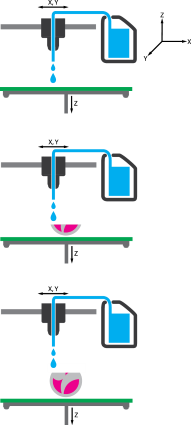
Material jetting resembles traditional printing in its operating principle, which is one reason why the term “3D printing” has become widely adopted. The process is very similar to conventional inkjet printing, with the key difference being that the material is fed into the print head(s) from larger material reservoirs.
To reduce the viscosity of the material, it is typically heated to an optimal temperature (usually up to 60 °C). The print heads move across the build area, and UV light is used to cure the freshly deposited material (if the material is UV-curable plastic). Finally, the surface of the printed layer is leveled to ensure good print quality.
Like inkjet printers, the print heads contain numerous nozzles, and the number of nozzles is generally directly proportional to the printing speed. In addition to speed, the use of multiple nozzles and print heads enables not only the use of separate support materials but also multi-material printing.
For a long time, material jetting-based 3D printers were almost the only option for producing full-color 3D prints from plastic. Color prints themselves are not rare, as color printing has been available for years in gypsum-based 3D printing (binder jetting) and paper-based 3D printing (laminated object manufacturing).
Material jetting processes are produced by companies such as Stratasys, 3D Systems, and Mimaki.
Each manufacturer has its own name for systems based on material jetting. Stratasys refers to its process as “PolyJet”, while 3D Systems uses the term “MultiJet Printing.”
Among these, Stratasys is clearly the market leader in color and multi-material printers. The company uses the term PolyJet for its material jetting process and has offered Objet Connex color and multi-material printers for several years. Its flagship model in 2020 was the Stratasys J850, which enables color and multi-material printing with up to seven (7) different materials simultaneously.
In addition to basic materials, multi-material printing allows for the creation of customized materials. Stratasys refers to these as “Digital Materials,” meaning materials formed by combining two or more printing materials in specific concentrations and microstructures. This enables the tailoring of desired properties in the resulting composite material.