Applications of 3D printing in various industries:
The Use of Additive Manufacturing in Industry
There are significant differences in the use of additive manufacturing across different industrial sectors. Many sectors already know how to take advantage of the method in the production of prototypes and tools (e.g., molds), but companies that have developed a comprehensive strategy for the use of the manufacturing method both in terms of production and business are still rare. The benefits of using additive manufacturing should be measured not only in terms of manufacturing costs but also in terms of the properties of the end product, the supply chain, and the added value received by the customer.
Aerospace Industry
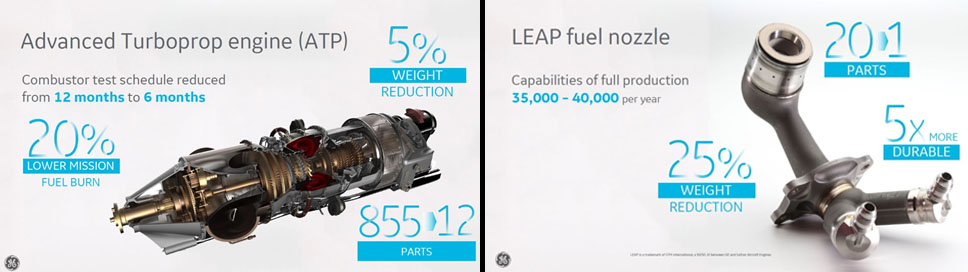
The aerospace industry is one of the pioneers of additive manufacturing. This is quite evident, since in the aviation industry the weight of the material is significant, the materials used are more expensive, and the price of the part is generally not a major criterion as long as the desired component meets the requirement. Regarding the 3D printing materials used, this industry often highlights technical specialty plastics (PEEK, PEI/ULTEM) for plastics and metals such as titanium and Inconel.
Airbus stated as early as 2015 that its Airbus A350 XWB aircraft contains over 1,000 3D-printed parts. The majority of these parts are made from ULTEM 9085, and the company noted that utilizing 3D printing allows for the production of components that are 30-55% lighter and can save up to 90% of material compared to previous methods. The aircraft does not contain only plastic parts, as the front bearing housing of the XWB-97 aircraft engine developed by Rolls Royce is 3D-printed from a nickel alloy. The part measures 1.5 meters in diameter and 0.5 meters in thickness. Rolls Royce estimates that using 3D printing can reduce production time by up to 30%..
GE Aviation is probably the company that makes the most use of metal 3D printing in the world. As a result of a development project, the company began producing fuel nozzles for LEAP jet engines using additive manufacturing as early as 2016. The reasons for producing fuel nozzles with AM methods are straightforward – the new nozzles are 25% lighter, five times more durable, and consist of just one part instead of the previous 18-part assembly. Each jet engine has 19 fuel nozzles, and with a backlog of well over a thousand engines, GE will manufacture hundreds of thousands of fuel nozzles using additive manufacturing during this decade.
Automobile Industry and Motorsports
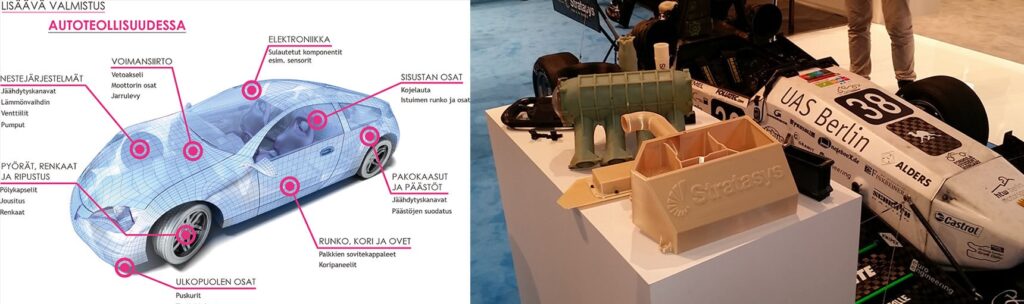
The automobile industry extensively utilizes 3D printing, for example in research and prototype manufacturing, producing spare parts for old components, making molds and tools, as well as manufacturing final products/parts. Currently, the manufacturing method is also somewhat used in the production of final products, and several car manufacturers have 3D-printed parts in their new car models.
Numerous car manufacturers also offer 3D-printed spare parts for older car models, as it is clearly cheaper to produce small quantities of parts through printing than to maintain inventories and mass production methods for them. This reflects a change in the mindset regarding what manufacturing methods can be used for.
So far, 3D-printed end products have been produced in small quantities compared to mass-produced items, so the main interest lies in using 3D printing alongside traditional manufacturing to enhance it. One reason for this is that 3D printing/additive manufacturing is well suited to the needs of mass customization. The range of cars/models offered by car manufacturers has grown rapidly over the past 20 years. A case in point is Audi, which had 7 different models in 1997, but by 2015 had 42. This requires flexibility and quick responsiveness in tools and manufacturing processes—areas that can be influenced through the use of additive manufacturing.
Even at this moment, additive manufacturing has a significant impact on the automotive industry, and the manufacturing method produces hundreds of thousands of parts annually for the needs of the automotive industry. In the future, the use of this manufacturing method will also be seen in the direct production of end products (such as a car chassis).
Energy Indystry
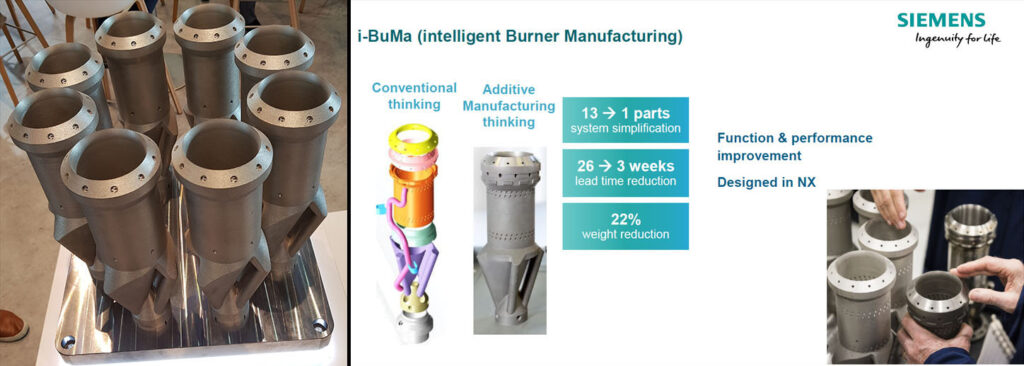
A good example of the application of 3D printing in the energy industry is the process developed by Siemens for repairing and upgrading the tips of gas turbine burners. Gas turbine burners, and especially the tips, are constantly exposed to temperatures exceeding 1000°C. This causes wear particularly on the burner tips. The traditional way to repair burner tips is to pre-manufacture a replacement part, cut off the old part, and weld the new part in place. This is labor-intensive, time-consuming, and involves numerous steps and measurements to ensure component accuracy.
Siemens’ idea is to replace the traditional method with a solution based on AM technology, where the worn part of the burner tip is machined away, and a new tip is grown directly onto the burner using AM methods. Compared to traditional methods, this has many advantages: the amount of material to be removed is minimal, and the repair lead time is reduced by 90% compared to before. In addition, during the repair, the burner tip can be upgraded to a new, more advanced version at the same cost as the repair.
Furniture Industry
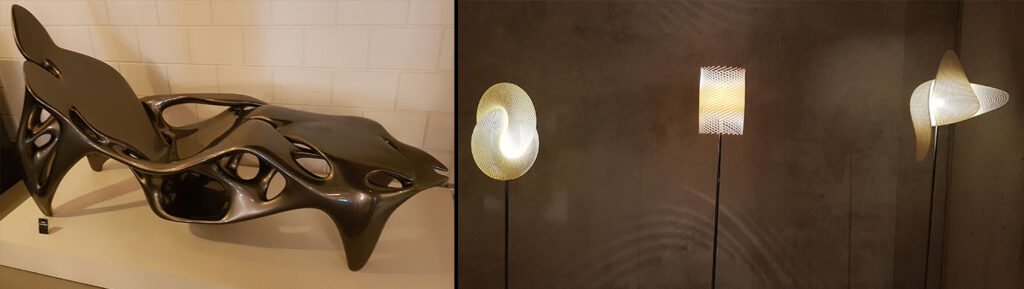
In the furniture industry, 3D printing enables geometrically more complex parts and customer-specific product customization. Additionally, multi-material methods allow the production of several different materials at the same time, offering opportunities for various furniture concepts, as well as tighter integration of lighting or electronics directly into the furniture during the manufacturing phase. One example of this is the Gemini armchair designed by Neri Oxman, which utilizes both traditional manufacturing methods and 3D printing with multiple materials with varying elastic and acoustic properties.
One currently intriguing area is the use of 3D printing methods for utilizing recycled materials in the furniture industry. Some research and concepts have indeed been developed in this field, where recycled plastic is used as a material for robotic 3D printers.
Mechanical Engineering Industry
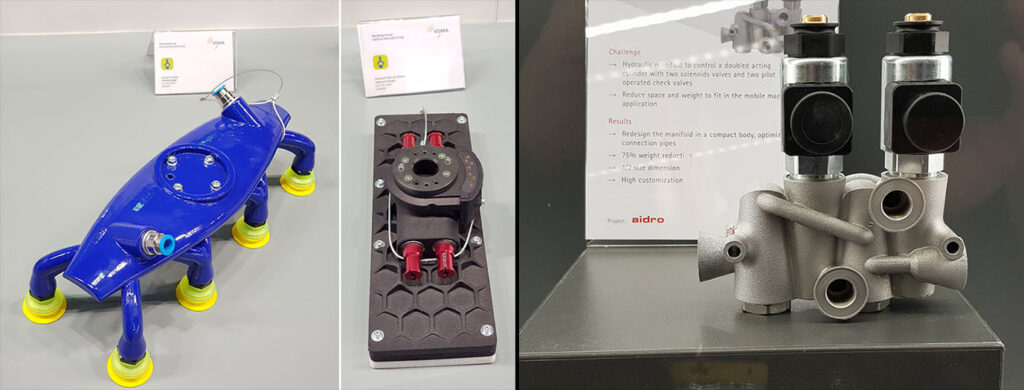
In the mechanical engineering industry, the utilization of 3D printing is still currently focused on supporting actual production. Applications include, for example, molds, tools, fixtures, and prototypes.
However, we are now in a phase where additive manufacturing is being integrated into existing production. The use of the method is particularly evident in mold manufacturing. Single-use sand casting molds have already gained recognition among companies in Finland as well, significantly speeding up and reducing the cost of producing cast parts on a fast schedule.
In terms of durable molds, Finland is not yet as advanced as other parts of the world, where, among other things, durable molds with significantly better cooling properties than traditional molds are manufactured directly to meet demand. 3D printing allows for free modeling of cooling channels – molds that cool faster can have a very significant impact on the speed of the production line.
Because the needs of mold manufacturing require dimensionally accurate prints, in practice all metal molds are machined after production. New hybrid techniques integrate machining into the manufacturing process, allowing a finished mold to be produced directly in one go.
In addition to mold manufacturing, additive manufacturing is currently also utilized in the machine shop industry for producing tools from both metal and plastic. 3D printing allows for the rapid creation of tools for various purposes, which especially accelerates the production speeds of new products.
Textile and Shoe Industry
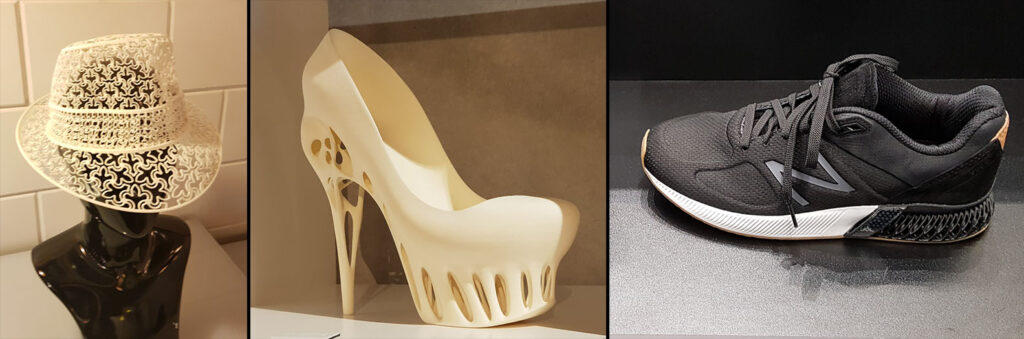
The fashion industry has always been bold in experimenting with new manufacturing methods in search of the next trend. With 3D printing, hats, shirts, jackets, and shoes have all been made with varying degrees of success.
In the shoe industry, numerous major manufacturers, led by Adidas and Nike, are using 3D printing to improve the flexibility of shoes. Sometimes entire shoes are printed, but currently the most common application is shoe midsoles, where 3D printing allows for the creation of a flexible lattice structure, even customized for customers. Adidas produces hundreds of thousands of pairs of shoes annually using 3D printing.
Construction Industry
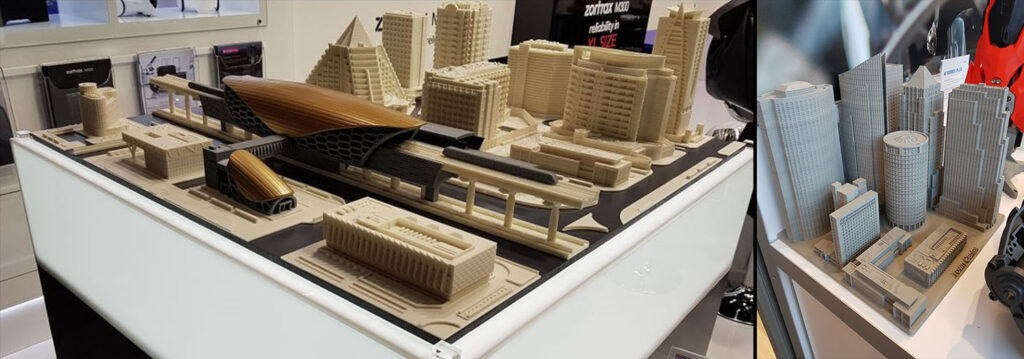
The construction industry is one sector that 3D printing is going to significantly impact. The most common applications are architectural models and design models, but the use of additive manufacturing directly in construction-related activities is becoming increasingly widespread.
There are numerous examples from around the world of both 3D printing buildings from concrete and manufacturing various tools (e.g., molds, support structures) using robotic printing methods.