Applications of 3D printing in various industries:
Additive manufacturing in the health and dental sector
Healthcare applications
Applications in medicine and healthcare are already widely available around the world. These include, among others, the production of implants and customized implants, anatomical models, the production of customer-specific prostheses, the manufacturing of surgical instruments, as well as the production of various drilling and cutting guides.
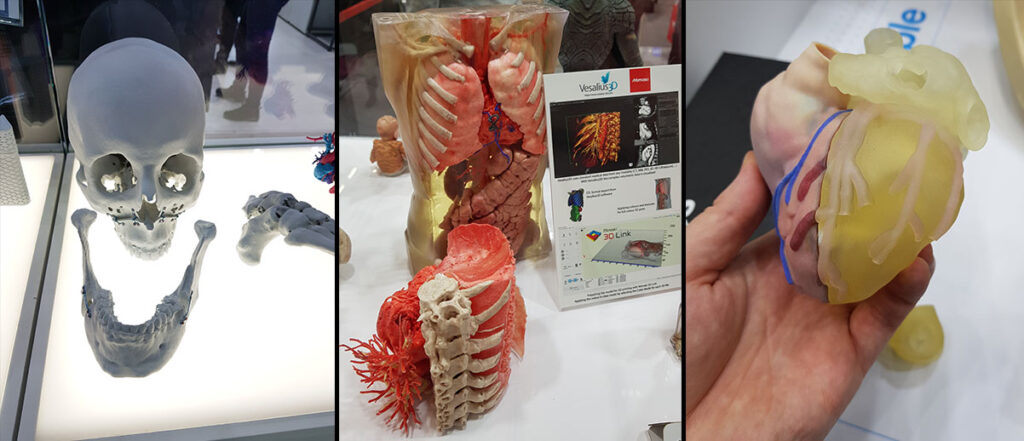
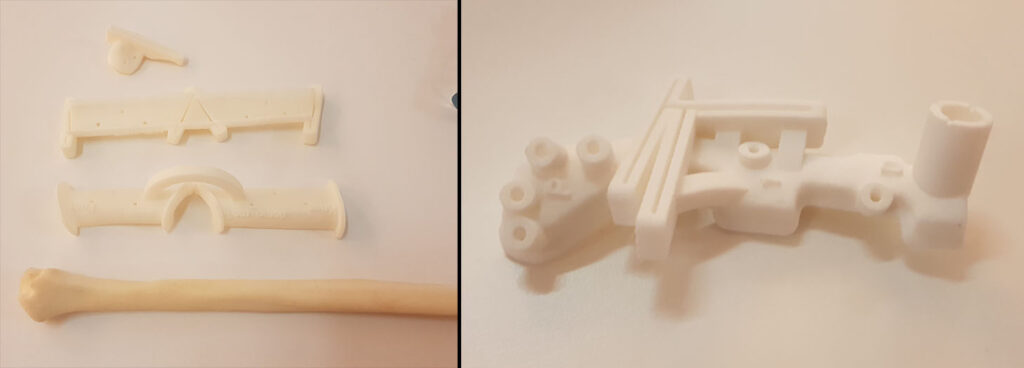
Anatomical models are made based on the patient’s imaging data and are used not only in the planning and preparation of surgical operations but also in the training of doctors. Typically, anatomical models are utilized in neurosurgery, oral surgery, facial and jaw surgery, plastic surgery, spinal surgeries, orthopedic surgeries, as well as ear, nose, and throat surgeries. Common applications for anatomical models include bending metal plates for fixation and measuring and manufacturing customized implants.
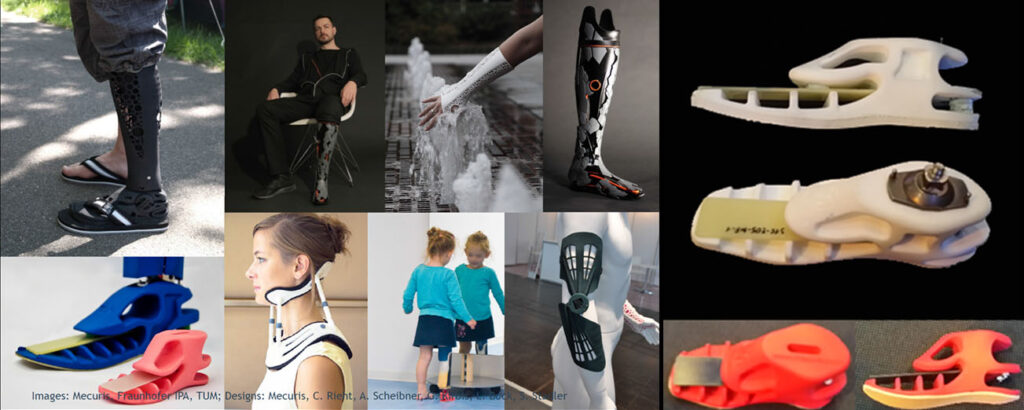
The production of custom-made prosthetics using 3D printing enables inexpensive and rapid redesign when the patient’s condition changes. This manufacturing method is particularly advantageous in the case of growing children and adolescents, as it significantly benefits the prosthesis production process. 3D-printed prosthetics have been featured in the news, especially in competitive sports, where they enable even more effective athletic performance.
Drilling and cutting guides are one example of patient-specific customized tools that have been shown to provide significant technical advantages for the surgeon, health benefits for the patient, and economic benefits for the hospital. As a technical advantage, a guide customized according to the patient’s anatomy ensures that the surgery is carried out according to plan and reduces the possibility of human error. As a health benefit to the patient and an economic benefit to the hospital, it can also speed up the surgical process by several hours. The use of 3D-printed guides is already common worldwide, with Finland lagging a few years behind in this regard.
Dental sector applications
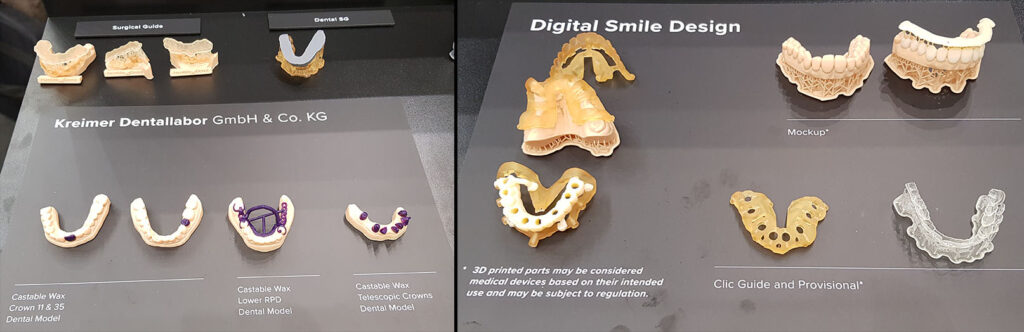
On the dental side, the most 3D-printed parts in the world are found, and the field is generally one of the most extensive users of 3D printing. Millions of metal dental crowns and bridges are produced annually using 3D printing. Invisalign, for its part, produces (transparent) aligners through 3D-printed molds, over 220,000 pieces per day. The company now has several competitors, so the number of aligners produced daily is considerably larger. It is likely the world’s largest 3D printing application in terms of printing volume.
In Finland, dental laboratories also widely use 3D printing for the production of various dental models. The models are used in the manufacture of dental appliances and help ensure that the appliances fit the patient’s mouth. In this respect, 3D printing (combined with 3D scanning) has replaced the use of plaster models. Bite splints are also manufactured using 3D printing, but their material properties are not yet at the level of traditional materials.